Wednesday, April 15, 2020

Orlogrove

After leaving Nemigan's orchard, most of the valleys we passed through were uninhabited. They continued to be roughly similar to each other: long, narrow strips of green between the bare golden peaks of the dunes, where scatterings of grass, cacti, shrubs, and small trees had grabbed the endlessly flowing waves of sand and rooted them in place.

Most valleys had a small shrine somewhere, usually by the deepest pool in the stream. (There was always a stream.) Apparently, each valley had its own local spirit - perhaps many spirits, if what I saw in Nemigan's valley was any indication - and someone long ago had taken the trouble to travel between the valleys, building a shrine to each one.

Spirits like to have shrines. They are forgetful creatures themselves, or at least remember in very different ways than we do, and many of them find it reassuring to have a shrine reminding passersby that they exist. Also, like most people, they are fond of well-crafted presents.

These shrines were certainly well-crafted. I couldn't identify the speckled gray stone they were carved from, which was neither the typical Golden Desert sandstone nor the pink granite from the gargoyle village, but it was quite hard; the carvings were old, coated with moss and lichen, but they were hardly worn at all. The stone was clearly not from anywhere nearby either. It must have taken a lot of work to transport it across all these dunes.

After my travels in Mollogou, where there's a spirit and a shrine for every hill and hummock, this place seemed oddly familiar - in an upside-down sort of way.

Karlishek and Garnet steered us away from a handful of valleys that, as they put it, smelled wrong. Nothing appeared obviously different about them from the outside, but after the first three or four, I also began to notice myself feeling faintly uneasy around them - the sort of vague sensation that I might normally have dismissed, but which I should perhaps learn to pay more attention to here. Not every location's spirit is a friendly one, especially in the less populated regions of the world.

Other valleys we avoided for different reasons. One we passed by simply because of the cheeky smile on the stone rabbit that adorned its shrine, a hand of cards pressed close to its chest with one paw. None of us were so starved for excitement that we felt like dealing with a trickster. Another had what was clearly a stone grave marker - much more crudely carved than the modestly adorned stone block that served it as a shrine - placed in the ground under its only tree. Though it didn't feel uneasy or hostile, there was an inward-turned sadness about the valley that caused us to quietly pass by and leave it alone. Spirits don't age or die the way that faster-living mortals do, and their mourning periods can last for centuries.

For the most part, though, the valleys were quite pleasant to wander through. It was a relief to be able to rest in the shade of trees again, however stunted, and hear the trickle of water nearby. Though there were no more inhabited valleys for some time, we found plenty of food in the ones we passed through. There were more desert apples and puddens, the occasional cluster of gumdrop cacti, and even a few edible mushrooms. In the sheltered spaces between bushes, we found the occasional cluster of wormflowers - fat, succulent, pink blossoms with a surprisingly sweet flavor.

We were lucky to have Karlishek along; none of the rest of us were familiar enough with the flora of the Golden Desert to reliably know if most of it was edible. Although he couldn't identify every shrub, cactus, and tuber we encountered, he was, in most cases, able to separate the benign from the poisonous or the unhelpfully hallucinogenic.*

Garnet continued to wander off and bring back various fractions of edible animals, depending on how long it had been since we'd last eaten, and Mogen turned out to be surprisingly deadly with a miniature crossbow she pulled out of her pack on the second day. As a result, we had roasted sand quails or brush millipedes to eat on most nights. (brush millipedes, admittedly, are not exactly difficult to catch; they can approach the speed of flowing tar when they feel frisky.)

All of our encounters with rattlesnakes, scorpions, and crocodile centipedes remained happily brief and long-distance. In an encounter between a crocodile centipede and the wagon gafl, the gafl would probably have won - they are heavy, unappetizing, and not extremely sensitive to venom, even in large amounts - but we preferred to avoid finding out for certain. Whenever we saw the long hummock of sand that marked a buried centipede, we made sure to give it a wide berth.

The shrines were endlessly fascinating. There seemed to be little to no pattern to them. Some were representational, carved with people, animals, or beings somewhere in between, in styles ranging from elegant to comical. Some featured only geometric shapes, or abstract sculptures that seemed to hint indirectly at a subject or a personality. One appeared to be an entire geometric treatise in the form of carved pictographs - something relating to the intersections of circles - although none of us were mathematician enough to understand it.

The design of a shrine seemed to have little obvious correlation to the apparent benevolence of its valley. One of the valleys we avoided was as tidy as a well-tended garden and had quite a lovely shrine, an elegantly carved swan with very little moss or lichen covering its form. It was pretty enough, but we felt distinctly that untidy things such as visitors would not be welcome. The next valley we avoided was the opposite: its floor was choked with underbrush, and moss completely obscured the face of the seated stone woman that made up its shrine. None of us were willing to step over the ridge into that valley, though we couldn't have said precisely why. Perhaps Garnet and Karlishek put it best: it just didn't smell right.

In contrast, one of the valleys that felt the friendliest had a shrine decorated with a border of carved skulls. They were small enough that they weren't visible from the edge of the valley (which was why we entered it in the first place). The valley's trees were hung with vines full of plump, blue-black grapes - which smelled pleasantly sweet, although we didn't quite dare to sample them - and the dense foliage overhead provided deep, much-needed shade during the middle of the day (which was why we didn't leave immediately). Once our initial alarm at the shrine's macabre design had faded a little, it was difficult not to feel comfortable in the valley. We stayed until the worst of the midday heat had passed and left wary but unharmed. Perhaps the spirit's aesthetic sensibilities simply tended toward the funereal.

We stopped for the night in a valley with a stone fish half-buried in the middle. It was similar to the standing stones that we'd seen near the abandoned canyon town, including the slow trickle of water leaking from its mossy stone gills. Unlike the standing stones, this fish was neither facedown nor faceup; it was simply propped sideways against a larger stone, as if someone had set it down there absentmindedly and forgotten to come back for it. Several small trees had grown up around it, and the water from its gills had worn a groove in the valley floor, becoming a small tributary of the stream.

The sun was nearing the horizon by then, and our thoughts were starting to turn to where we were going to spend the night. Despite its forgotten appearance, the fish was the first sign of civilization - aside from the shrines - that we'd seen since leaving Nemigan's house. Taking it as a good sign, we set off into the valley, which was somewhat longer than average, to see if there were any current residents to meet.

We found no other buildings or obviously artificial structures, but Karlishek pointed out that many of the trees and other plants were arranged in small copses, overgrown but still distinct. In most cases, there were visible differences between one copse and the next: slightly larger apples, for example, or flowers of a more vivid pink. Though the valley was short on architecture, it seemed to have an abundance of horticulture.

Finally, at one end of the valley, we found a gap beneath an overhanging boulder - a natural shelf of sorts, sheltered from the infrequent Desert rain. It was stuffed with books. They were old and dusty, but still in good condition. Most had at least one or two pages marked with scraps of paper or dried leaves. Though there were no footprints in the patch of sand in front of the shelf - which was damp from the nearby stream and would certainly have shown them - the shelf immediately around the books was clear of sand, as if they'd been moved recently. We were careful not to disturb them.

The whole valley had a charmingly distracted feeling about it. The flowers were thicker than in most valleys, with the remnants of order about them, like a garden left to run wild. Many of the trees had a bonsai sort of elegance. Even the rocks were often arranged in ways that looked deliberate, though overgrown. It was like visiting the workshop of someone who's constantly excited about their newest skill or project, surrounded by work that's perpetually not quite finished, but lovingly crafted all the same.

By that point, we had explored the entire length of the valley, and we were fairly certain that it had no mortal inhabitants. The obvious next step was to introduce ourselves to the local spirit.

The valley's shrine looked like a trio of wooden cabinets, though they were all carved from a single block of moss-furred stone. The two taller cabinets leaned together conversationally over a smaller, wider one, leaving a sheltered triangular space in the middle for offerings. All three cabinets were pleasantly asymmetrical. Their mismatched drawers were open just enough to show tantalizing glimpses of the objects inside (also stone): a book, a branch, a stack of coins, a set of drafting tools.

Most of the drawers, by now, were lined with moss. Another layer of moss was beginning to grow over the few tarnished coins left on the middle surface. It looked as if the shrine hadn't seen any new offerings in some time.

If one is simply passing through a spirit's home, a respectful acknowledgement of their presence is usually sufficient courtesy. As we were hoping to stay the night, something a little more substantial was in order.

In Mollogou, the details of a shrine often hint at the sorts of gifts its spirit appreciates. Hoping that such was the case here as well, we went through our various supplies for any likely-looking books, tools, plants, or currency. Most of what we were willing to part with fell into the latter category. For once, my habit of collecting interesting coins, rather than more sensibly spending them, proved useful.

We dismissed the various coins from the Golden Desert as too mundane; likewise, the small sum of Lint that I keep due to its widespread acceptance in most countries. Spirits almost never need to purchase anything, and we assumed that this one would appreciate novelty over denomination.

In the end, we left an intricately carved ivory coin from the Blue Desert, a three-sided coin from Tetravania called an Oak's Head,** and a clockwork coin from Miggle-Meezel that plays a simple eight-note tune when one turns the gear in its center. (I was reluctant to part with the clockwork coin, but I do have three others like it.)

The offering seemed to be sufficient. We spent a pleasant, peaceful night beneath the valley's absentmindedly tended trees, unmolested by insects or kleptomaniac centipedes. When we woke in the morning, the flat rock in front of the shrine had been laid with breakfast for five: fried apples and sand quail eggs, still steaming on plate-sized pieces of slate. A small fire was just burning itself down to embers in a ring of stones nearby. Though we'd taken turns on watch through the night, due to the unfamiliar territory, the shrine was just far enough away from our wagons that none of us had seen or heard the food being prepared.

As if that wasn't enough, after we finished breakfast, we found that a few rips in the canopy of Chak's wagon had been neatly sewn up with green thread, and someone had braided flowers into the gafl's fur. A small heap of flowers lay nearby, as if the braider had gotten distracted by something else partway through. Both gafl were happily munching on them.

In short, although we never caught sight of our host, their hospitality was impeccable. We all stopped at the shrine to express our appreciation before leaving the valley. When we boarded the non-aquatic wagon and found a sealed letter sitting hopefully on the driver's seat, weighed down with a pebble painted to look like a lopsided frog, I don't think any of us even considered not delivering it.

According to Chak, who had the best command of Jingli among us, the letter was addressed - in archaic but readable script - to a Gingrin Hilljarvel in Pandagula. ("Gingrin" is an academic title, roughly equivalent to "Doctor.")

The sender was marked simply as "Orlogrove."

Whether that's the name of a person or a place, or whether there's any difference between the two when discussing spirits, none of us were certain. If we manage to locate Gingrin Hilljarvel, perhaps we'll find out.

---

* I asked, at one point, if there were any plants that were helpfully hallucinogenic. Karlishek smiled with his antennae. "None that you'd know how to use," he said.

** I asked several people during my time in Tetravania why it's called an Oak's Head, but - as this was Tetravania - I received a clear answer from precisely no one. The closest thing I ever got was "well, oak trees don't have heads, so something has to." After a few weeks in Tetravania, one gets used to this sort of thing. Far more confusing is the fact that the coin, which appears to be a typically coin-shaped flat disc of metal, somehow has three faces on its two sides; one has to flip it over not twice, but three times, to arrive back at the face one started with. The results of a coin toss are by no means to be trusted.

Labels: , , , , , , , , , , , , , , , , , ,

Saturday, June 08, 2013

Unexpected Canines


A few days later, the desert had lowered into a slightly more fertile valley lined with rocky cliffs. It was probably too dry for agriculture - there was a sluggish trail of muddy water down the middle of the valley, no more - but the sand was sprinkled with grass and wiry little bushes. We even caught sight of the occasional goat, though they were always darting out of sight behind rocks by the time we noticed them. They were far warier than we were.

In hindsight, that probably should have told us something.

We walked downstream ("stream" being a generous term) for another day or two. Running water tends to lead to more running water, and enough running water will eventually have people living by it. This is true nearly anywhere in the world. The food - animal and vegetable - was far more plentiful in the valley, and there were occasional clear pools where we stopped to refill our water. Occasionally, there were even trees with enough shade to sit in. Rattlebirds and orange-furred marmlets stared at us from high in the rocks. They scuttled away when we looked at them.

On the third day, we found out why all the animals were so skittish. The valley had gotten deeper, winding in sharp zigzags beneath the sandstone cliffs. There were occasional spots where the water actually trickled instead of oozed. We were in much higher spirits than before. We were walking beside the stream, debating whether marmlets were edible or poisonous like their cousin the nightshade gopher, when we came around a rock and found a pack of saber-dingoes staring at us.

Everyone froze.

Saber-dingoes have gained something of a bad reputation in the Golden Desert; unfortunately, they have earned most of it quite honestly. The most common theory is that they are descended from only the nastiest bits of wild dogs, lions, and wolverines. In most parts of the world, the wild canines - wolves, jackals, thylacines* - will leave people alone, correctly judging that these bizarre upright creatures with their fire and metal are much more dangerous than any wild predator. Saber-dingoes are different. They will not attack large groups of animals - hence the use of caravans for desert travel - but they will not hesitate to attack anything, no matter how large or well-armed, as long as they outnumber it.

There were four of us. There were eight dingoes. The smallest of them probably weighed more than Garnet. We had a few knives between us, ranging from bread knives to potato peelers; the dingoes had claws and teeth. They also had the fangs for which they are named, two each, serrated blades as long as my forearm that hung down to either side of their chins. If anyone had been placing bets, they would not have been on us.

We had been downwind of the dingoes, and they had been busy dividing up a dead goat, so they were as surprised as we were - but considerably more pleased. In moments, they had left the goat behind and were slinking toward us with the casual, eager grace of a predator who has just spotted much larger and better-fed prey.

We raised such pathetic excuses for weapons as bread knives and backpacks and tried not to panic. The goat did not look as if it had had a chance to run very far.

That was when Garnet came out from behind us. We tried to stop her - pointlessly, as a few feet more or less of distance was clearly not going to make much difference to the dingoes - but she shrugged us away and kept going.

She stopped, facing the ranks of saber-toothed grins, and began to grow.

Thick, black fur sprouted along her arms and neck, and her loose clothes rustled and shifted as muscles and limbs expanded beneath them. We could hear her bones creaking. In what seemed like an eternity but was probably less than twenty seconds, there was a nine-foot-tall black werewolf with claws like a velociraptor standing where the small woman had been. She was still wearing the same delicate pink sari she'd had since leaving the caravan. It looked positively tiny on her now.


Wordless, she pulled back her lips and growled at the pack, giving them (and us) a clear view of fangs that would have put a crocodile to shame.

The pack held very still for a second. Then, without the slightest twitch as a warning, the largest saber-dingo - a male with a ragged mane - sprang for her throat.

She met him halfway. There was a brief scuffle, full of flying sand and snarls like ripping cloth. The two of them paused just long enough for us to see that she had somehow gotten her teeth around his throat - he probably would have lost it if not for his mane - and then she flexed the muscles of her neck and shoulders and threw him fifteen feet into a sand dune. She was on him again before he could get back on his paws.

The other dingoes tried to leap at Garnet as soon as her back was turned. After all, the point of a pack is not to attack things alone. The rest of us shouted warnings, and she backhanded them across the sand before they could get near her. They gave up after only a few tries.

The largest one was far more stubborn. I won't go into detail about the rest of the fight, except to say that he was bleeding from a dozen wounds - none of them fatal; she seemed uninterested in killing him - and was missing most of his left ear by the time he finally gave up, crawling away with what remained of his tail between his legs. The rest of the pack followed him without a sound.

Garnet stood there, panting, and watched them go until they were out of sight behind the next bend in the valley. She turned and gave us an apologetic grin with too much red in it.

"Sorry if I frightened you," she said, and collapsed.

It took all three of us to drag her over to the stream. We had cleaned her wounds, as well as we could, and were just starting to bandage them when she shifted back to human. Every cut promptly healed on its own. This is fairly normal for shapeshifters; they never stay wounded for long. When you're reshaping your entire body, there's no reason to leave holes in it.

Garnet remained unconscious until after sundown. When she woke up, she emptied the nearest pool of water, ate our entire supply of dried meat, and followed it with everything that remained of the dingoes' goat. If she hadn't been so exhausted, I suspect she would have gone out into the dark to catch another one.

When she had finished, she apologized again for frightening us and for not telling us sooner. We assured her that no apologies were necessary. After all, if she hadn't been there, we would have been not only frightened, but rather unpleasantly dead as well.

We had to admit, though, that we were rather curious.

Garnet had come from a part of the Desert where werewolves were rumored to live, she said, but none of her relatives could remember there being one in the family before. Apparently, it's a trait that can skip many generations before it shows up again, like blue eyes in a dark-eyed family, or carnivorism in a family of herbivores. She confused her parents to no end as a teenager. She was always hungry - she could out-eat everyone in her family - but she never seemed to actually grow any larger. No one was sure where she was putting it all.

They found out when she changed for the first time, at age fifteen. She had been growing - but not in her normal body. Instead, it had all been going into that mysterious little side pocket of existence where werewolves keep their extra mass. The first time she changed, she destroyed her dress and half of the room she was in, mostly due to panicking and exiting through the nearest wall.

She's been careful to wear loose clothing ever since, just in case.

She stays human nearly all the time because it's easier, she said; she weighs less, eats less, hits her head on fewer doorways, and is far less hot without all that black fur. Also, walking around as a nine-foot pillar of muscle and sharp ends tends to frighten people.

"Actually," she said with a rueful laugh, "it frightens me a little too. It's too big, too strong, too pointy. Most of the time, I just try to forget the wolf is there." She paused for a moment, then smiled. "I guess it was good to have it today, though."

We all quite emphatically agreed.


* Yes, I know that thylacines are not technically canines, but they take much the same role in the parts of the world where they live. The same is true for houndworms, cerulean monitor lizards, and the feral candroids in a few of the wrecked floating cities.

Labels: , , , , , , , , ,

Tuesday, July 10, 2012

Sky-Hunch


I'm starting to think it's just something about this stretch of road. Today was my third encounter with someone who couldn't speak to me - at least not in any way I could understand.

Just like yesterday, I had been walking for most of the morning when I saw a dark shape in the distance, just off the road. I couldn't tell what it was at first. A blanket? A dead tree? The outline shimmered in the heat haze and refused to resolve itself into any shape I recognized. I had to get much closer before I realized what it was.


It was one of the flying hyenas.

Even the ordinary, ground-dwelling hyena is an oddly proportioned creature: thick-bodied and front-heavy, all neck and shoulders and ears. Its back slopes up from short back legs to a high, domed head, with a scruffy mane of fur along the spine. Its neck is almost as thick as its waist. The little tuft of tail almost seems like an afterthought.

Flying hyenas are stranger still; all of their proportions have been exaggerated even further for flight.This one had bat-like wings easily twice as wide as the span of my arms, and its toes were unusually long and flexible, somewhere between paws and talons. Its chest was massive. It takes truly amazing flight muscles to lift a creature the size of a hyena. The Desert name for the flying hyena - sarkotha - means something like "sky-hunch," and now I can see why. Most of the animal seemed to be shoulders and a long, muscular neck heavy enough to balance its small hindquarters in flight. Like a bat, there was webbing between its tail and its hind legs.

I don't know whether it was male or female. Unlike most mammals, there is no obvious way to tell male and female flying hyenas apart except that the females are larger, and I'd never been close enough to one to make a comparison. This one was large enough to be frightening, even lying sprawled on the sand.

The hyena's fur was gray-brown with a pattern of black spots. The bare skin on its wings was much the same. The wings were tough, translucent membranes, like those of a bat, leathery and wrinkled at the joints. Enough light shone through from the sand that I could see red and blue blood vessels beneath the surface.

There was a loop of rope tied around the hyena's left wing.

I'm not sure how the rope had gotten there in the first place. Maybe someone had left it somewhere, and the hyena had gotten tangled in it; maybe someone had actually tried to catch the creature. If so, they must have been insane. I could see its fangs from where I was standing. The area around the rope was red and swollen, chafed by the fibers and the hyena's teeth. It looked as if the hyena had been worrying at the rope, trying to get it off, and had only succeeded in pulling it tighter. The membrane was so constricted by now that the wing probably couldn't have opened completely - which explained why the hyena had been traveling on foot. From what I've heard, they never walk when they can fly.

Judging from the tracks in the sand, it had walked for a long time, and dragged itself for a long time after that, before collapsing from exhaustion or dehydration. It wasn't moving. I was fairly sure that its eyes were shut, though the dark rings around them made it hard to tell. Until I noticed the faint rise and fall of its shoulders, I wasn't sure if it was even alive.

It was clearly alive, though. That was all I needed to know. Aside from the fact that I hate to see anyone suffer, I've read enough fairy tales to know the proper course of action in situations like this. That rope had to come off somehow. I set my bags down a safe distance away and rummaged through them until I found my bread knife. It was a less-than-ideal tool, but I needed something with teeth to cut through rope that thick, and I don't carry a saw around with me. The bread knife would have to do.

(The picture above, by the way, I drew later, from memory. This was a situation that called for either helping or running away, not standing around sketching.)

The hyena didn't move when I approached. It seemed to be unconscious. It made a noise when I touched it, somewhere between a snarl and a snore, but it didn't open its eyes. Gingerly, trying to shake the beast as little as possible, I crouched by its wing and started sawing at the rope.

It was a long and difficult process. The sun beat down mercilessly. It had been bearable when I'd only been walking; sawing at a rope was much more strenuous, and therefore hotter. The rope seemed to part at a rate of one strand per hour. As slick as it was with my sweat and the hyena's saliva, it was hard to even hold onto it. I was terrified that I was going too slowly and would never finish, that I was going too quickly and would wake up the hyena, that it would wake up anyway and bite my arm off. Somehow, I managed to keep going.

I had almost finished when I became aware of a low rumbling sound from somewhere nearby. I looked down to find a pair of dark eyes, ringed in black, glaring at me above a wrinkled muzzle. The hyena was growling.

I had no idea how long it had been awake, but that was obviously a sign that I was out of time. Fortunately, one last yank of the knife was enough. The last strand of rope parted, and I scrambled away as fast as I could without stabbing myself or turning my back on the hyena. I got to what seemed like a respectful distance and then went a bit further.

The hyena didn't get up immediately; it sat there, baring its teeth at me in a snaggly bear-trap snarl that would have put a crocodile to shame, until I was far enough away to satisfy it. Only then did it stagger to its paws. It moved gingerly at first, favoring its injured wing; something must have felt different, though, because it turned away from me to look. The tendons flexing in that great neck were as thick as my wrist. Cautiously, it unfolded its wing, and the frayed rope slithered off and fell to the ground.

The hyena gave its wing a tentative flap. Then, with a thoroughly inhuman cackle that raised all the hair on my spine (never mind that I don't have any right now), it beat both wings in the most ferocious takeoff I've ever seen and flung itself into the air. The river was fairly nearby, just over a few small hills. Apparently, they'd been too much for it to manage before; with its wing unencumbered, though, it swooped right over them. I could hear the splash when it dove into the water.

I climbed over the hills and sat just behind the crest of the last one, watching the hyena. It drank at first, lowering its head into the sluggish current and chomping down water in great, famished gulps. Having dealt with its thirst, it just stood there for a while and let the water wash over its wing. It took several minutes for the swelling to start going down. After that, the hyena romped and splashed around in the water in what looked like sheer joy, kicking and scooping up big waves with its wings. It shook itself like a dog when it finally climbed out.

It froze when it saw me. I'm not sure what it was thinking. On a human, its expression would have looked like a perplexed frown, as if there was some puzzle it was trying to work out. We stood there and looked at each other for what seemed like forever. Finally, the hyena dipped its head in what might have been a nod, then turned and loped away up another hill. It lifted into the air with another ghastly cackle and flapped off into the sky. I watched it until it was out of sight.

I didn't do any more walking today. Instead, I went to lie in the river myself for a while, until I was less overheated and my hands had stopped shaking. It had been wonderful to see the hyena back in the air, free to return to the element it was born to rule. I was glad I'd been able to help it.

But I hope I never have to do anything like that again.

Labels: , , , , , , , , , , ,

Friday, June 03, 2011

Hmakk

One of the best parts of my time on the Pinstuck Plains has been learning the language. The civilizations of the Scalps grew up in a land of huge, open distances. As a result, their language is meant to be sung, shouted, or yodeled as much as spoken. It's called Hmakk.*

I've heard Hmakk shouted from a distance, back when I was traveling with the basket nomads. The clan I was with spotted another one in the distance. Instantly, they erupted with noise, screaming and shouting at the tops of their lungs (which tend to be quite powerful on a Scalp traveler).

This sort of situation is when Hmakk is at its best. Its hard-edged words carry for miles. Though I was nearly deafened by the shouting around me, though I couldn't even see the faces of the other clan, I could hear every syllable they shouted.

"Hni, TiMa! Tile paka hasnakk?" (Hey, TiMa! How is your daughter?)

"Hmaleet mi tle pakyan tiri! Ale powrak kesyameet le hakk!" (Beautiful and growing far too fast! She has trained her first weasel!)

"Preet, preet! Tisa mika hatsa puyrak hnetka…"
(Good, good! My son is learning to weave…)

Every member of the clan seemed to be shouting at once. Through the ringing in my ears, I could hear questions about families and courtships, deaths and births, crafts and stories, travels and tribulations. The young children of the clans shrieked back and forth about beetles and mice they'd caught. The conversations continued long after anyone else in the world would have been out of earshot. A few girls trailed at the back of the group, yelling to their cousins, until the other clan had vanished over the horizon. My hearing returned in a day or two.

As a language meant to be shouted, Hmakk often sounds like cursing even when it's not. I've met a few people in other parts of the world who, when they want to intimidate someone with a stream of incomprehensible profanity, simply count to twenty in Hmakk. ("Hakra tekna khisri HNUYKEMIT…")** It's quite terrifying if you don't know what it means. Actual Hmakk cursing is even more so. The most eloquent (and angry) plains-dwellers can peel paint with their words, and I don't mean that metaphorically.

For the same reason, it's a wonderful language for singing. Nothing can be sung with more enthusiasm than a Hmakk song. They are sung from somewhere below the stomach. Some are straightforwardly percussive, marches and haknits*** and mining songs as sharp as a pickaxe. Many rattle along at blinding speeds, unstoppable as the hot steel of the Train. Others are surprisingly gentle. There's a song called Tehmyana that is simply about the sunrise (which is what its title means). It takes the hard consonants and howling vowels of Hmakk and softens them, blends them together into something clear and smooth, like ice crystals melting into water.

Poetry is written in every language, and Hmakk is no exception. Not all the poems of the Scalp are hard and abrasive.

Just most of them.


* Most consonants in Hmakk are pronounced with somewhat more force than usual, hence the extra H when written in our alphabet. The HM in Hmakk should be pronounced as if trying to speak while coughing. The double K, when pronounced properly, sounds like splitting wood. I have yet to manage it. Apparently, this is one of the best ways to tell a native Hmakk-speaker from a learner like myself.

** …Hepikk sischuy tetya hokk hnitka tett plootya treykya strachney khat-hnuy khat-pikk khat-sis khat-tet khat-hokk khat-ka hlastekk.

*** The haknit is, to the best of my knowledge, a type of song unique to the Scalps. Other music is written to convey emotions like love, or joy, or love, or sadness.**** A good haknit is pure indignant rage. It is a rant, a tirade, a musical dressing-down. Apparently, there's a group of women in SuyMaTmakk who are famous for them. I'll have to try to hear them perform if I'm ever there.

**** Or love.

Labels: , , , , , , , ,

Friday, June 25, 2010

Tunnelers

I took a detour from the path back in May, when I was still in the mangrove swamp. There was a gathering of alarmingly large coconut crabs on the boardwalk, and I didn't feel like trying to go through them. Several were snipping branches off of the trees with their claws and waving them over their heads like flags. I kept my distance and climbed off into the mangrove roots.

It turned out to be surprisingly easy once I got used to it. They were old mangroves, their roots firm and gnarled, with plenty of footholds. Crabs of the ordinary size scuttled away into crevices when they saw me. I tried to stay out of the water; I'm not sure where the estuary becomes fresh enough for leeches. Twilight arrived as I traveled, turning the humid air beneath the trees a dusky blue-green. In the half-dark, I smelled the smoke before I saw it; I'm not sure I would have seen it at all otherwise. This is not what one expects to smell in so humid a place, so I stopped and looked around to see where it was coming from. A thin plume of smoke was rising from the corner of one of the roots. When I bent down to look at it, I found what looked like a tiny incense burner, a smoking brazier in miniature. There were no grasshoppers nearby. The roots were untouched and free of even the oldest bite marks.

That was when someone began throwing small twigs, with perfect accuracy, at my head. I moved away immediately. This sort of greeting is often followed by showers of small but extremely sharp arrows. Once I was out of range, I looked out into the trees and saw that over half of them were inhabited, full of tiny lit windows like stationary fireflies.

They were full of Tunnelers.

The twigs stopped when I had moved a few feet away from the incense burner, which I assumed to be some sort of grasshopper repellent. The last things miniature people want are giant insects eating their houses. I looked around before moving again, making sure I wasn't about to step on anything and provoke more twig-throwing (or worse). This sort of violent reaction from Tunnelers is completely understandable, as people my size are quite capable of accidentally crushing their fields and buildings before we even notice they're there. Our attention has to be gained quickly and emphatically.

Tunnelers are, to the best of my knowledge, the smallest people that anyone my size knows about. They tunnel in things, hence the name. Many live underground in holes dug by domesticated moles. Others live in walls or the unused spaces of machinery. The Arboreal Tunnelers are one of the most widespread tribes; most of Hamjamser's forests have at least a few trees full of them. They're harder to see in the daytime unless you know to look for the tiny shutters in the bark. Arboreal Tunnelers generally confine their excavations to the dead wood of trees, taking care not to harm the living parts except to punch through a window here and there. Entirely dead trees don't make the best homes; they have a tendency to rot and fall over. Tunnelers rarely go outdoors, as nearly everything outside wants to eat them, so it was unsurprising that I couldn't see any of them. I've never seen a tunneler; I don't even know what they look like. Even the twig-throwers never showed themselves. Every so often, one of the windows would flicker as someone moved in front of it, but that was the only sign of life that I saw.

I'm sure I was making them nervous, standing there, so I left after another look at the candlelit trees. I took a different route back and found the usual latticework warning markers set up along the edges of the boardwalk. Apparently, not many travelers leave the path in that part of the Great Shwamp.

The coconut crabs were gone by then. They'd set up the branches in a cone, like the frame of a teepee, and had set a large conch shell on top. I left it alone. I don't know what it was meant for, but it certainly wasn't for me.

Labels: , , , , , , , ,

Wednesday, June 23, 2010

Fish of the Sun

I left the gregarials yesterday after a breakfast of fish and green cheese. (It comes from the green cow. Her name is Pickle.) In exchange for the hospitality, I left them a jar of dark green oil paint. As I mentioned, one of the gregarials is an albino, white-scaled with bright pink eyes; he has difficulty hunting, as he practically glows in the dark.* I can easily pick up more green at the next town I come to, and he could use some camouflage that won't wash off in the water.

The following day was relatively quiet; the gregarials carried me across the river on half of a boat that they have, wished me well, and sent me on my way. It took longer to get back to the main river than it had to get away from it, so I ended up spending a night in the open after all. Oh well. I'm used to it. I would have slept quite well if it hadn't been for the owls hooting in Morse code over my head.

Today, like every day in the last week, it seemed as if the sun had come down to bathe in the river. Steam rose from the water. The light reflecting from the packed dirt of the road was blinding. I kept to the trees as much as possible, their shade nearly black in comparison to the sunlight. Even there, the air seemed something to be drunk rather than breathed. I reached the river road slightly before noon, hardly a hundred feet from where I left it two days ago. The Tetravanians would be proud. It seems like a lot of work to cross that much distance, but I'm glad I did; I got to meet the gregarials, after all. I looked back at the branch that had caused the detour, that torrent of fast water that had been too strong for me to sail across, and was shocked to see someone wading in it.

Normally, I would say she was a large, fluffy samoval, but I don't think I've ever met one who was less than eight feet tall and didn't make a sheepdog look bald in comparison, so there's really no need. This one was no exception. She was plowing through the water, waves breaking against her waist, stomping as if she was trying to kill something with her feet. She was in the deepest part of the river when I first noticed her. As she started to reach the shallower parts, her head got higher... and higher...

If she wasn't at least nine feet tall, I must have shrunk a lot in the last few weeks.

She was wearing a wide-brimmed hat the size of a wagon wheel. It was almost wide enough to shade her shoulders. On one shoulder, she was carrying a four-foot jar full of what looked like orange juice. Every so often, a flash of red scales and fins was visible inside. Her fur was black at the roots, but she had dyed it a pale yellow, possibly to make it less hot in the sun. If so, it didn't seem to be working particularly well. She was panting in the heat. As I watched, she let out a roar of frustration, threw her hat into the bushes, put down the jar - I was afraid she would throw that too, but she put it down with exquisite care - and flung herself headlong into the river. The wave nearly capsized a little canoe passing by.

"A Thousand Thousand Curses on this abominable fur!" she roared, erupting out of the water again. The man in the canoe nearly tipped over out of fright this time. "Even in the cool of the shade, it Roasts me like a very Oven, and gives me no peace by Night or by Day! I swear this moment, in the hearing of all who hear me, I shall endure it no more! I shall cut it off! To the last Strand shall I sever this coat of Evil, and cast it into the Mud to be trampled by Cattle and Pigs! You!" She pointed with a massive fist at the terrified canoe-paddler. "Have you Scissors? Give them to me!"

The man babbled something about not having any scissors, sorry, goodbye, and paddled off at a speed I didn't know was possible in a canoe. I could see sunlight underneath the keel.

The samoval turned and caught sight of me. "You!" she said, sloshing over to the bank. "You are one who has Scissors. I can tell. You have the Look. Give them to me." She held out one enormous hand. I took a look at the claws on it and decided not to argue.

My scissors looked like nail scissors in her hand, but she managed to get the tip of a finger through each handle. Her fur stuck out in spikes as it dried in the hot air. She cut each one off as if it had personally insulted her. She started walking again as she worked, picking up her hat and jar again on the way by. The jar must have weighed more than I do; she lifted it easily, with one hand.

I had little choice but to follow her. I only have the one pair of scissors. Fortunately, she was going in the same direction I had been traveling anyway. She stomped along without another word, pounding dust out of the road, hacking away at her fur with every step. She somehow managed to hold the jar in one arm while trimming with the other. Cutting evenly seemed to be of no importance; after an hour, her arms had a sort of mangled hedge look to them. The scraps of dyed fur that remained made a sort of diced lightning pattern over the dark roots. The scaled thing continued to flicker in and out of sight in the glass jar. After another hour or so, the samoval seemed less completely enraged, so I asked her about it.

"This is my Fish," she declared. "He is a handsome Fish and quick of Fin. I am raising him in the Fruit of the Sun, so that he shall be a Giant among all Fishes and possess the power of Flame. The Waters shall steam where he Swims."

After that, she was quite willing to talk, though the conversation was rather one-sided. Her name, she said, is Mahalia Peraximander the Third. (The Fish is from the Unseen Deeps and does not yet have a name.) She is apparently part of the royal family of a place called Crucible, "a Great City of Fire and Iron." Having found her Fish, she is returning there. She's fifth in line for the Throne, "but unlikely ever to claim it," she said. "For we are a family of great Strength and Stubbornness, and it shall be many Years till the Death of my Uncle, if indeed Death ever dares to disturb him at all."

I wonder if everyone in Crucible talks this way. I suppose I'll find out. It's going to take a long time to cut all that fur.


* His name is something like Plrzzxgak. I can't pronounce it any better than I can spell it.

Labels: , , , , , , , ,

Tuesday, June 08, 2010

Cracks in the Mud

I've been traveling for weeks over dark, still water, so deep that the roots of the giant trees are completely hidden. They rise like wooden pillars from a floor of black marble. The water's getting shallower now, though; the cypresses are showing their roots, not just their knees. Some of the ridges between knee and trunk are high enough to stick out of the water. A few of the oldest trees have whole flying buttresses. There are stands of cattails here and there, clustered around the trees like green cuffs on wooden sleeves, and sedges with seed clusters in every imaginable shape. It's early in the year for them, but things tend to grow out of season in the Great Shwamp. I picked a few stems of box-sedge near the boardwalk. Each branch was tipped with a perfect little cubical seedpod, punctured at the top to let out seeds, like a tiny saltshaker. (I've heard that some mice actually use them that way.) Another sedge nearby had seeds arranged in perfect five-pointed stars. Mounds of red mud rose from the water a bit farther on; they were mostly bare, except for a few tufts of marsh grass. They had an uneasy, temporary look to them.

I began to suspect that the calmness of the water was not as constant as it seemed. The only solid things in sight, besides the immovable trees, were new ground and even newer plants. There had been storms here recently.

The mounds got larger as I walked, still bristly with marsh grass and the occasional sedge. Some of the larger ones had dried on top. The surfaces were cracked in the crazed patterns of dried riverbeds. A man in spectacles and a rather dusty coat was splashing between them, making rapid, precise sketches of the patterns. One trouser leg was rolled up; the other had fallen down and was dangling in the water. He didn't seem to notice. His feet were scaly and webbed, like a duck's.

"Good morning," he said, not stopping to look at me. It was late afternoon. "Stay on the boardwalk, please. Don't step on the mudbanks."

He needn't have worried. Even the driest ones were obviously the sort of mud that eats your boots and stains your socks for eternity. I had no intention of stepping on them; I told him so. He didn't seem to be listening.

"I've got to record them," he muttered. "Just a few more dry spells should do it. I'm so close. So close. It's almost complete."

"What's almost complete?" I asked.

He turned and stared at me as if I had asked what air was. "The message, of course!" he sputtered, blinking furiously. "You don't think these patterns just happen, do you? They're written! Written, I tell you, and I'm going to find out by whom! It's taken me years to decipher the language. No one else would even try. I'm so close... So close..."

He stared into space for a moment, lost in what I assume was thought, then seemed to lose all his patience at once. "Why am I even talking to you? I don't have time to waste talking! It could rain any minute and erase part of the message! There are two mudbanks I haven't recorded yet! I can't afford any more distractions! Get out!"

I got out. I was tempted to stay nearby (out of sight, of course) and wait for the reader to finish - just to see what happened - but despite his hurry, there's no telling how long that could take. It could be weeks before the rain comes and erases the cracks. Even if I could find somewhere dry to sleep, I don't think I could resist following the boardwalk that long. I have to find out where the path leads.

In his own way, I suppose, so does he.

Labels: , , , , , , ,

Thursday, November 27, 2008

Linewurm

The Train came around a curve this afternoon to find what looked like a lizard-shaped heap of scrap metal shuffling along the tracks. It was almost as large as the engine. When it saw the Train, it got off the tracks in a hurry, shedding machinery and pots and rusted sheet metal as it went. The noise was horrendous. It sat by the tracks as the Train went by, lashing its tail and hissing at us. The combination of clanking and hissing sounded like a steam engine about to explode. Its teeth were quite impressive. There were storm-drain gratings fitted over its eyes.

I only recognized the junk-heap creature from photographs and descriptions in books; I'd never seen one above ground. The Train had surprised a linewurm.

Small dragons and their relatives, such as salamanders, are usually content with anything metal. That's one of the many reasons to keep salamanders in lanterns; they've got a piece of shiny metal that's bigger than they are. Craftsmen's salamanders are generally happy with their ovens or forges. The ones in the great metal hulk of the Train - or, better yet, the floating cities - must feel like kings.

Large dragons usually have more refined tastes. They prefer gold. This is by no means true of all dragons, or even most, and the less obsessed ones can get rather unpleasant if you imply that it is. Quite a lot of dragons these days collect gears, or teapots, or umbrellas, or any number of the other pretty things that people make. I know of half a dozen off the top of my head who collect only books. (Frankly, I don't know why everyone doesn't do that, but you know how I feel about books.) Some don't collect anything - though most dragons consider those ones eccentric, or possibly just lazy. Still, all the most traditional dragons collect mainly gold and the occasional gemstone.

The linewurms - distant relatives of dragons, like giant white newts - have almost nothing in common with their winged cousins except their size and their love of metal. They certainly don't share their brains. Even the most uncivilized and temperamental dragon can outthink most smaller creatures; when you live for centuries and have a brain larger than an entire cow, you can hardly help it. Linewurms are considerably less intelligent. They spend all their time hoarding things. They prefer metal, but they'll settle for rocks. They're not picky. When they find something nice and hard, they glue it to themselves with the mucus they secrete, making their own armor plating to cover their soft bodies. They make claws out of old knives and pickaxes stuck to their toes. When two linewurms meet, provided they don't find each other attractive (and most of them don't), they fight. The fact that their claws and scales are secondhand and handmade makes them no less eager to use them. They fight, and the winner takes whatever useful bits and pieces are left on the floor when the loser runs away. The focus is generally on knocking armor off rather than actually hurting each other.

In other words, linewurms collect stuff to fight and fight to collect stuff. People have suggested that they could just leave each other alone, but the linewurms don't seem interested. Perhaps there's nothing better to do down in the caves.

The mucus that holds linewurm armor together eventually covers it with a thick white layer, like glue, giving the metal (and other assorted junk) a pearly shine and softening its edges. It reduces the clank of metal on stone to a quiet rustle. Old linewurms look like the ghosts of junkyards. The mucus also coats the insides of the caves where they live, turning rough stone passages into the smooth tunnels that linewurms prefer.

This, incidentally, is where linewurms got their name: they are wurms* that line stone with slime and line themselves with stone. It seems like rather a pointless cycle, but linewurms seem to like pointless cycles.

A rare few wurms have been known to make sculptures out of mucus, building them up layer by layer with the patience of a cave drip forming a stalagmite. Most don't have the patience.

The hardened mucus is said to be like tree rubber, only better, and there's gotten to be quite a trade in stolen linewurm upholstery. People go down into their caves and peel the coating off of the walls. It's a job for only the exceptionally brave or foolish. Linewurms grow to be several hundred feet long, keep themselves well armed, and suspect everyone they meet of being a thief. (To be fair, they're almost always right.) They're the main reason that abandoned underground villages stay abandoned. Linewurms like abandoned villages. People always leave such nice stuff behind. Fortunately, there's no shortage of abandoned underground villages in Hamjamser, so linewurms rarely need to bother with the inhabited ones.

Of course, not all linewurms live in the wild; quite a lot of them live in Mount Moler, primarily as garbage collectors. Once again, they're not picky. Lineworms have been known to live above ground, but only with completely opaque armor (they sunburn easily) and truly enormous sunglasses. It's extremely rare to see one out in daylight. I still have no idea what the one we saw today was doing. According to the passengers at the back of the Train, it got back on the tracks after we passed, clanking away behind us and lashing its tail angrily. It stopped first to pick up some of the pieces it had dropped.

Later in the day, when the Train stopped at the village of Hoggen, I found a horseshoe and the crank handle from some piece of machinery - a gramophone or pepper grinder, perhaps - caught on the front of the engine. Shreds of rubbery mucus still clung to them. The crank handle looked quite old, an elegant piece of Caroque brasswork. I brought them in and put them in my suitcase. I think I'll hold on to them for a while. It's not every day you get your hands on a piece of a linewurm's coat-hoard. Who knows - maybe I'll get a chance to return them someday.


* "Wurm" being the term for the amphibious variety of dragon. Not to be confused with "worm" (a limbless invertebrate), "werm" (any other limbless animal, such as furry snakes and nullipedes), "wirm" (a long, segmented robot), or "warm" (the same as hot, but slightly less so). "Wyrm" refers only to scaled dragons (though in some parts of Hamjamser, it's considered rude and therefore highly dangerous to use the word to their face). Why we can't just use completely different words for all of these, I have no idea.

Labels: , , , , , , , , , , ,

Tuesday, November 13, 2007

Traveling Companion... or... something

First of all, O relative of mine who has a birthday today, happy birthday!

Second of all, I am now traveling with a llama. I came across a stable yesterday, by the side of whatever road this is, next to a small market and a lemonade stand. The two reptiles that run the stand are trying to get rid of all their remaining lemonade so that they can switch to hot tea and cider for the Winter. They don't see the point of wanting to cool off in the first place, being reptiles, but they make good lemonade anyway.

I'm not one to pass up opportunities like this, so my meals for the last two days have consisted of baked paisley slug and carrots from the market (they're not selling much else that isn't pickled by this time of year), paisley slug stew from the llama stable (it doubles as an inn, so it serves more than hay and salt. Guess where the owner shops), and half-price lemonade. It's been interesting.

There were no llamas staying at the stable when I got there, so - rather than keep lugging my bags around - I stayed overnight. It could be weeks before I find another one. Fortunately, I didn't have to wait long; when I woke up this morning, there was a llama in the stall next to mine. (Doubling as an inn doesn't mean they have any actual rooms.) He was wearing a pair of rather scratched spectacles and chewing some thorny plant as if he wanted to break its bones.

We introduced ourselves. Since I was looking for a llama and he was looking for someone looking for a llama, it was really the only thing to do, but I don't think he enjoyed it much.

His name, he said, was Plack; he didn't care much for people at the moment; the last one whose luggage he carried ran off after a two-month journey without paying him. He had to spend all the money he had left just to stay in the stable last night. He would have skipped the stable altogether, but it's November in the Mountainous Plains, and it was raining. He was not happy. He informed me that I would pay him the full four Loundas before he would carry so much as a sock for me; that my luggage would be padlocked to his carrying harness; and that he would keep the key in his mouth. That way, if I ran off before the trip was over, it would be my problem.

You might think that after being paid, he wouldn't care what I did, but the money is less than half the price to a llama. Customers of llamas are expected to groom them, take care of their traveling equipment, and do more or less anything else that requires hands. In a way, travelers don't hire llamas so much as they trade the use of their hands for the use of the llamas' strength. That's why llamas charge so little. They only need money for stables and repairs to their carrying harnesses.

As if carrying luggage weren't enough, llamas often protect the people they travel with as well. Very few things, no matter how nasty, will mess with a llama. They bite as hard - well, almost as hard - as they kick. Plack wanted to make sure I knew that, especially when he found out I had only a vague idea of a destination and generally just wandered around the countryside.

"You've traveled with llamas before, then?"

"No, actually. I've always carried my own luggage before."

He stared at me, as if luggage were the least of my problems. "What if you get attacked by bandits who've run out of pencils? What if a wild cathomar decides you look like a stupid, edible creature who wouldn't put up a fight?"

"It's never happened before..."

He gave me a disgusted look. "Well, it certainly won't happen while you're with me. Watch this."

With that, he walked over to a tree that was standing innocently nearby.

Fifteen seconds later, it was missing several branches and had four small, round holes straight through its trunk.

I didn't know llamas could spit THAT hard.

Labels: , , , ,

Tuesday, March 27, 2007

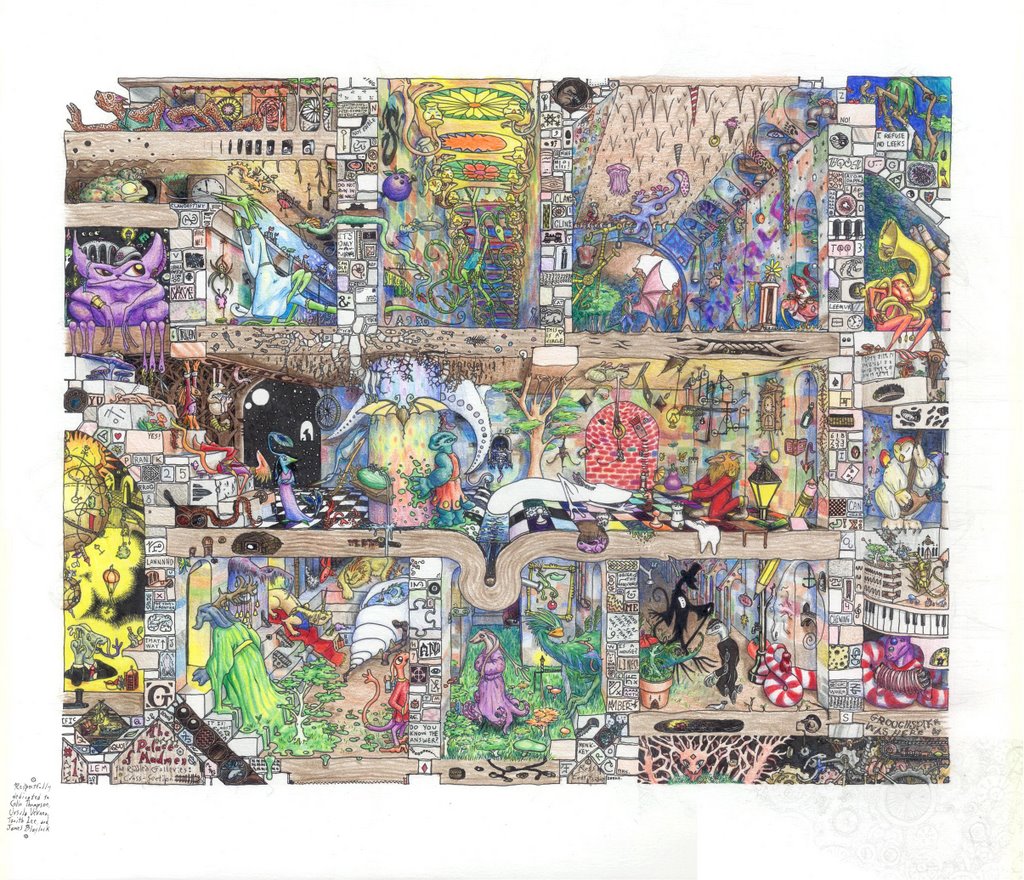
The Palace of Madmen


Interestingly enough, I visited the Palace of Madmen once (or the Changing Maze, the Sanctuary of Dreams, the Labyrinth of Many Names, the Heap, or whatever else you care to call it). I stumbled across one of the back doors. There are no front doors. I suppose you could say that I didn't actually go in - I only took one or two steps into the first room, keeping a tight grip on the knob of the door so that it couldn't get away. I'd heard about the place before. It's almost as hard to leave as it is to enter.

The one room I saw was roughly round, like the bottom floor of a tower, with an assortment of spoons and egg whisks branching like trees out of the ceiling. Mice fluttered through them and hung from prehensile tails. The floor was covered with mushrooms in every imaginable color, from amethyst and aquamarine to copper and cinnabar. A family of six-legged toads appeared to be eating spaghetti and jam on a checkered blanket on the largest one. Upon seeing me, they squeaked, turned immediately into bright green spiders, and attempted to hide against the tomato-red cap of their mushroom.

Of course, they were probably really hiding from the hooded burreler who walked into the room a second later, swinging a large pair of hedge shears on the end of his impossibly long tail. The hood on his head flowed seamlessly into a pair of chain-mail overalls festooned with buttons and elaborately braided green onions. Upon entering the room, he proceeded to shave the fluff off of a small mushroom-patterned carpet, the bristles off of a hairbrush growing among the spoons and egg whisks, and the fringe off of a large mushroom shaped like a lampshade. He was quite efficient. It took him roughly five seconds. All the mushrooms promptly crawled into the floor, spider-toads, picnic blankets, and all, shutting the stonework neatly behind them.

The Palace of Madmen takes in all types of lunatics, and - as far as I've heard - makes more sense to them than the outside world. Like most people on Hamjamser, the vast majority of them are friendly and perfectly harmless. Unfortunately, not all of them are. The maze welcomes the dangerous ones just as readily; it simply keeps the rest of its inhabitants safely away from them.

With the mushrooms gone, the burreler turned a pair of wild, sea-green eyes to me, which was when I noticed that he himself had no fur whatsoever, and his typical black-and-white burreler stripes were actually made up of tiny ceramic tiles stuck to his bare skin. He eyed my hair angrily, swinging his shears and muttering something about flagellated herring.

That was when I left. I didn't know whether or not the maze's protection applied to casual observers. I wasn't particularly eager to find out. The door made a faint ringing noise when I closed it hastily, and the knob folded itself into the faded purple wood with a sound like a silver crab retreating into its shell, leaving no trace in the seamless wood of the door.

When I stepped back, the door frame had gone as well. Only a rectangle of faint purple remained, no more than a stain on the plain wooden boards of the wall where it had been. The window next to it looked out onto the fog-draped fields around the little abandoned cabin.

There had been nothing in the sad little one-room building except the purple door, and now there wasn't even that. Wisps of fog drifted in through the window, split by the few remaining shards of glass. The floor and walls held nothing but shadows and a faint rectangle of purple. There was nothing to see. I left.

The Northern wall of the cabin, where the purple door had been, held only the blank, empty window on the outside. I hadn't noticed it on the way in. There was nothing particularly noticeable about it now. The boards were gray and warped in place. They had obviously stood there for decades, never disturbed by even the hint of a door, much less a purple one to a building out of a dream.

The cabin might have only existed to have the door in it, the one that had opened, shut, and vanished completely. I don't know why. Probably, there was no reason. It just was. That's how the maze works.

There was nothing to see, and there were quite a lot of hills between me and the town of Skither, and the thought of spending the night on the fog-smothered grass by (or in) the empty cabin with the door that wasn't was not particularly appealing, so I set out across the bedeweled grass without much hesitation. The cabin was lost in the mist when I looked back.

I've never found it again. And believe me, it hasn't been for lack of looking.

Anyway. This drawing is based on other stories I've heard of the Palace - from scholars who have spent their life writing in great detail about their few, cherished glimpses of it, from travelers like me who have stumbled across a door or two, and - very rarely - from a few of those who have lived there. There are not many of them. There are even fewer who ever leave. Most of them would rather die. Their descriptions are strange and ambiguous; real words, in the real world, are the wrong shape to hold stories of the Sanctuary of Dreams. This is the closest I can come to making sense of the least senseless accounts. I doubt I will ever attempt to draw my own glimpse of the Palace.

This is not a picture of the Labyrinth of Many Names. It is only as close - I hope - as a sane mind can come to it.

(Dedicated to Colin Thompson, Ursula Vernon, Tanith Lee, and James Blaylock.)

(Image copyright Nigel Tangelo / Ross Emery.)

Labels: , , , , , , , , , , , , ,

  • Stats Tracked by StatCounter